

Species Habitat Index
Overview
A METRIC OF
ECOSYSTEM INTEGRITY

COMPONENT INDCATOR OF
GOAL A
TAXONOMIC COVERAGE
TERRESTRIAL:




Media & Presentations

Methods
Habitat-suitable range
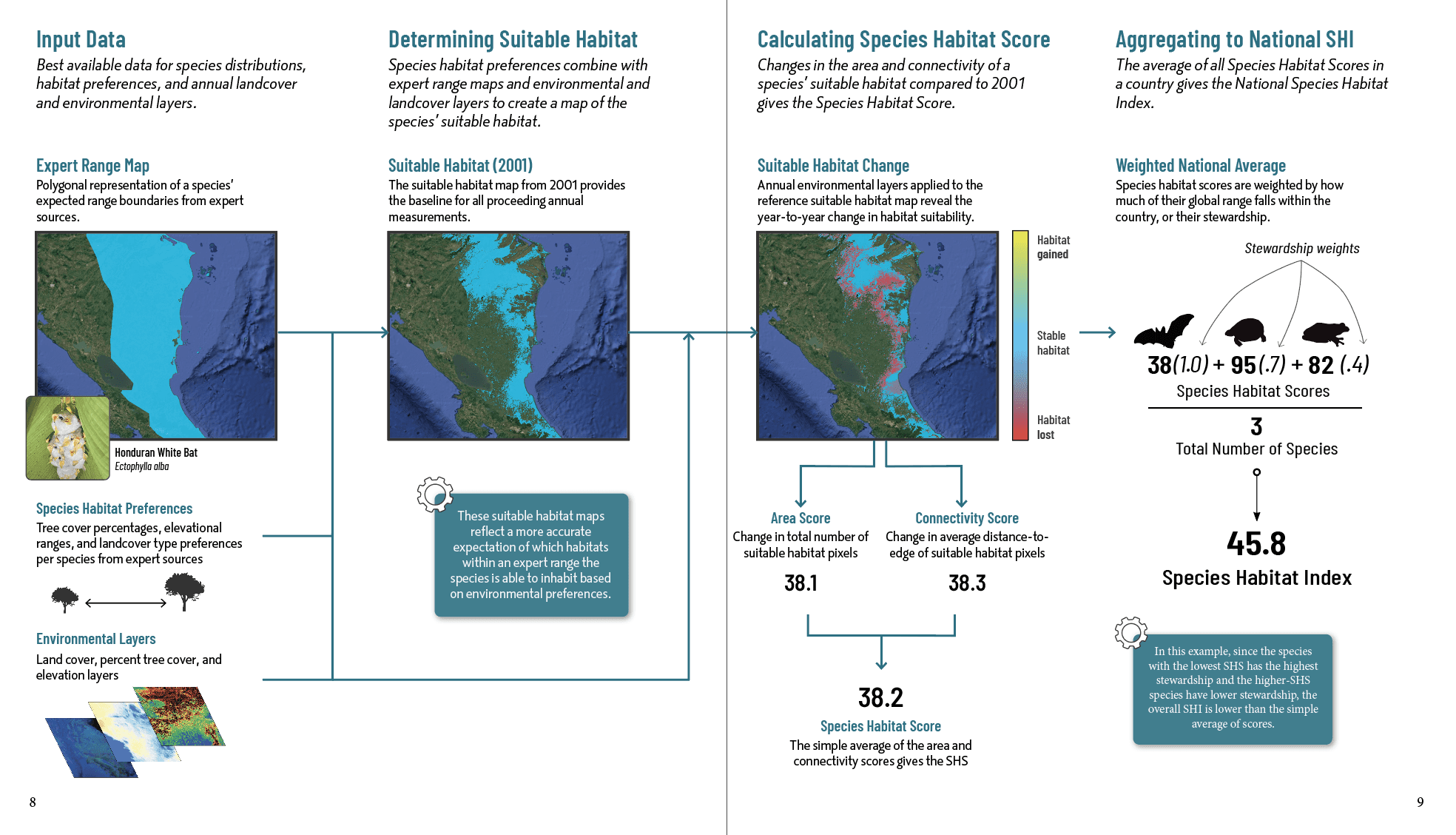
We apply statistical models incorporating species expert ranges, habitat preferences, environmental layers, and species occurrence points to develop species habitat-suitable range maps. These maps represent the habitats within a species range boundaries where the species is most likely to inhabit and therefore provide a more accurate representation of the size and distribution of the species range.
Species-level scores
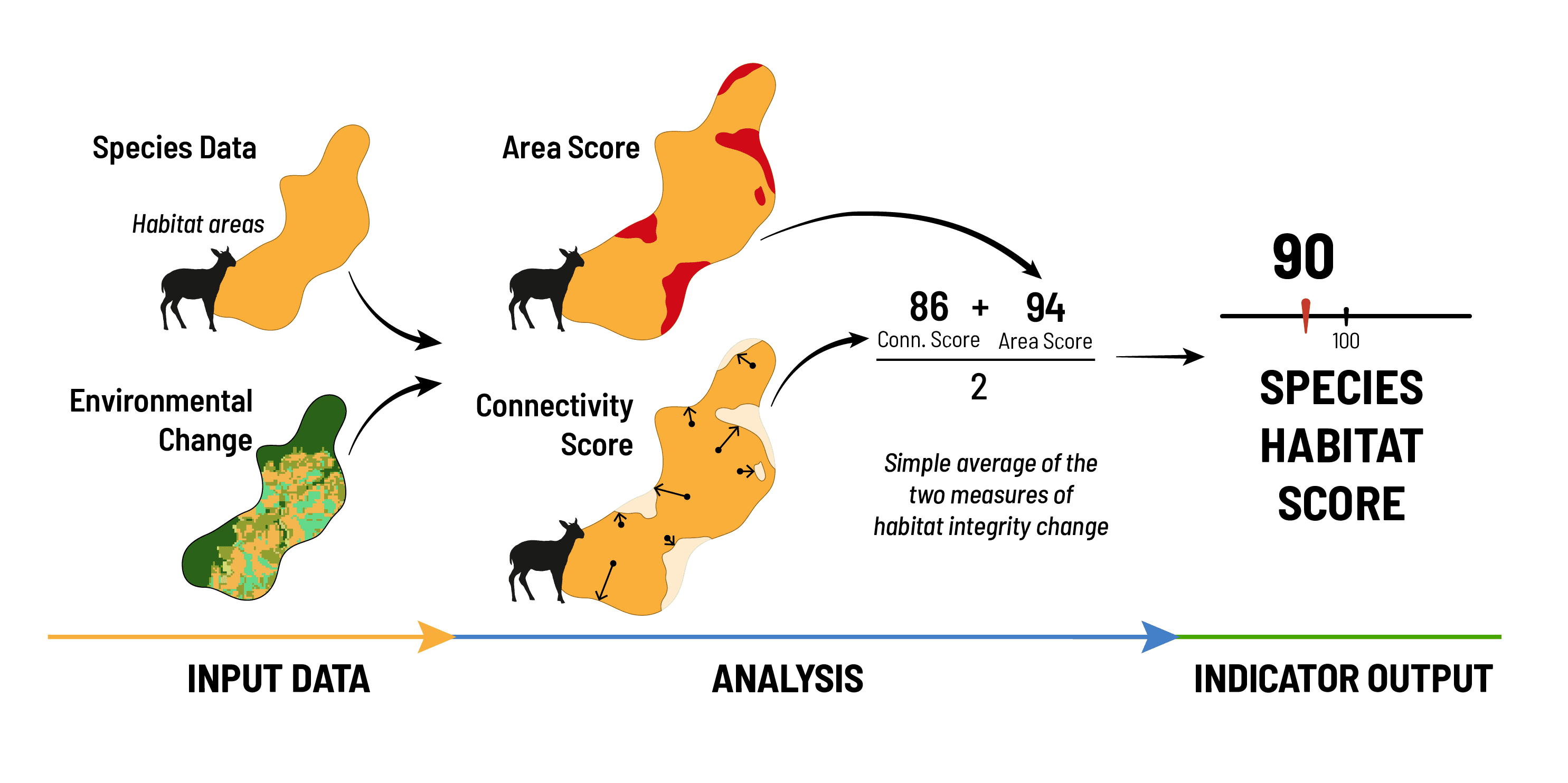
The SHI calculation is based on individual species habitat scores (SHS). The SHS measures change over time in the area and connectivity of species’ habitat-suitable ranges using 2001 as the baseline year. The SHS is given by the average of the area score and the connectivity score.
The area score measures changes in the size of the species’ habitat-suitable range. This is given by the product of summed suitability (continuous range of 0 – 1) of individual landscape pixels and their size. For suitability expressed in binary form (presence-absence maps) for 1 km2 pixel, this is simply the total presence pixel count.
The connectivity score measures changes in the average connectedness, or fragmentation, of the species’ habitat-suitable range. This is given as the average distance to the edge of the suitable area across all suitable pixels (a widely-used, robust measure of connectivity - GISfrag metric). For custom calculations at national level this can be extended to include other information, e.g. measures that weight the distance among habitats by the resistance to movement of the intervening landscape.
The area and connectivity scores are given as the change since 2001, where the baseline is represented as SHS = 100. Thus, a loss of 6% of habitat area would give an area score of 94 and a loss of 4% of connectivity would give a connectivity score of 96. The SHS is the simple average of these two scores, so this species would have an SHS of 95 compared to the reference year 2001.
National SHI
The SHI of a country or other geographic unit is given as the average SHS of all species within that unit. SHI values for a country can either be computed as the simple mean across species (National SHI) or by weighting species-level values by the proportion of the global population the country is estimated to hold (Steward’s SHI). In addition to reporting on the separate Area or Connectivity aspects of SHI, indicator subsets can address different species groups, e.g. species dependent on certain habitats and ecosystems, rare or threatened species, or those with particularly rapid recent habitat changes.
Sources
For the latest 2023 version of the SHI:
Species Range Maps
Species Group
Source
Amphibians
IUCN (2016). The IUCN Red List of Threatened Species. International Union for Conservation of Nature. Accessed on January 2017. Downloaded at www.iucnredlist.org
Birds
Jetz, W., et al. (2012). The global diversity of birds in space and time. Nature, (491);444-448. doi.org/10.1038/nature11631
Mammals
Mammal Diversity Database. (2020). Mammal Diversity Database (Version 1.2) [Data set]. Zenodo. doi.org/10.5281/zenodo.4139818. Map of Life. (2021). Mammal range maps harmonised to the Mammals Diversity Database [Data set]. Map of Life. doi.org/10.48600/MOL-48VZ-P413
Reptiles
Roll, U. and Meiri, S. (2022). GARD 1.7 - updated global distributions for all terrestrial reptiles [Dataset]. Dryad. doi.org/10.5061/dryad.9cnp5hqmb
Terrestrial vertebrates
Misc. literature and expert sources
Species Occurrence Points
All point datasets include data from 2001-02-01 to 2023-12-31.
Species Group
Source
Terrestrial vertebrates
GBIF.org (1 June 2022) GBIF Occurrence Download: https://doi.org/10.15468/dl.4hpkfz
Birds
eBird Basic Dataset. Version: EBD_relMay-2022. Cornell Lab of Ornithology, Ithaca, New York. May 2022.
Species Habitat Preferences
Species Group
Source
Terrestrial vertebrates
IUCN Red List of Threatened Species. 2025. Version 2025-2. www.iucnredlist.org. Downloaded on 2025-04-22.
Terrestrial vertebrates
Misc. literature and expert sources
Environmental Layers
Dataset
Source
Elevation
Amatulli, G., et al. (2018) A suite of global, cross-scale topographic variables for environmental and biodiversity modeling. Scientific Data (5);180040. https://doi.org/10.1038/sdata.2018.40. Available at www.earthenv.org/topography.
Land cover
ESA. Land Cover CCI Product User Guide Version 2. Tech. Rep. (2017). Version 2022. Available at: maps.elie.ucl.ac.be/CCI/viewer/download/ESACCI-LC-Ph2-PUGv2_2.0.pdf
Tree cover
Hansen, M. C., et al. (2013) High-Resolution Global Maps of 21st-Century Forest Cover Change. Science 342 (15 November): 850-53. Version 2023. Data available online from: glad.earthengine.app/view/global-forest-change.
Region Layers
Dataset
Source
Country boundaries
Database of Global Administrative Boundaries (GADM) version 4.1. Available online at gadm.org/data.htm.
Citations & Acknowledgements
CBD Secretariat (2021). CBD/WG2020/3/INF/6. 24 August 2021, Montreal. https://www.cbd.int/doc/c/2397/5133/3ce87fa6c735a7bf1cafb905/wg2020-03-inf-06-en.pdf
Jetz, W., McGowan, J., Rinnan, D.S., Possingham, H.P., Visconti, P., O’Donnell, B. & Londoño-Murcia, M.C. (2021). Include biodiversity representation indicators in area-based conservation targets. Nature Ecology & Evolution 6, 123–126. https://doi.org/10.1038/s41559-021-01620-y.
Hansen, A. J. et al. (2021). Toward monitoring forest ecosystem integrity within the post-2020 Global Biodiversity Framework. Conservation Letters. 14:e12822. https://doi.org/10.1111/conl.12822
Jetz, W. et al. (2019). Essential biodiversity variables for mapping and monitoring species populations. Nature Ecology & Evolution 3, 539-551, https://doi.org/10.1038/s41559-019-0826-1.
Navarro, L. M. et al. (2017). Monitoring biodiversity change through effective global coordination. Current Opinion in Environmental Sustainability 29, 158-169, https://doi.org/10.1016/j.cosust.2018.02.005.
Pereira, H. M., Freyhof, J., Ferrier, S. & Jetz, W. (2015). Global Biodiversity Change Indicators. 1-18 (GEO Biodiversity Observation Network, Leipzig, Germany).
Pereira, H. M. et al. (2013). Essential Biodiversity Variables. Science 339, 277-278, https://doi.org/10.1126/science.1229931.
Global assessment report on biodiversity and ecosystem services of the Intergovernmental Science-Policy Platform on Biodiversity and Ecosystem Service. 1148 (IPBES Secretariat, Bonn, Germany, 2019).
Powers, R. P. & Jetz, W. (2019). Global habitat loss and extinction risk of terrestrial vertebrates under future land-use-change scenarios. Nature Climate Change 9, 323-329, https://doi.org/10.1038/s41558-019-0406-z.
Yoder, A. D. et al. (2003). Single origin of Malagasy Carnivora from an African ancestor. Nature 421, 734-737. https://doi.org/10.1038/nature01303
Durán, A. P. et al. (2020). A practical approach to measuring the biodiversity impacts of land conversion. Methods in Ecology and Evolution 11, 910-921, https://doi.org/10.1111/2041-210X.13427.
Almond, R., Grooten, M. & Peterson, T. (2020). Living Planet Report 2020-Bending the curve of biodiversity loss. (World Wildlife Fund).
Leung, B. et al. (2020) Clustered versus catastrophic global vertebrate declines. Nature 588, 267–271. https://doi.org/10.1038/s41586-020-2920-6.
Ripple, W. J., Bradshaw, G. & Spies, T. A. (1991). Measuring forest landscape patterns in the Cascade Range of Oregon, USA. Biological Conservation 57, 73-88. https://doi.org/10.1016/0006-3207(91)90108-L.
Crooks, K. R. et al. (2017). Quantification of habitat fragmentation reveals extinction risk in terrestrial mammals. Proceedings of the National Academy of Sciences 114, 7635-7640. https://doi.org/10.1073/pnas.1705769114.
Oliver, R. Y., Meyer, C., Ranipeta, A., Winner, K. & Jetz, W. (2021). Global and national trends in documenting and monitoring species distributions. PLoS Biology 19, e3001336, https://doi.org/10.1101/2020.11.03.367011.
Hurlbert, A. H. & Jetz, W. (2007). Species richness, hotspots, and the scale dependence of range maps in ecology and conservation. PNAS 104, 13384-13389, https://doi.org/10.1073/pnas.0704469104.
Jetz, W., Wilcove, D. S. & Dobson, A. P. (2007). Projected Impacts of Climate and Land-Use Change on the Global Diversity of Birds. PLoS Biology 5, 1211-1219. https://doi.org/10.1371/journal.pbio.0050157.
Jetz, W. & Thau, D. (2015). Map of Life: A preview of how to evaluate species conservation with Google Earth Engine, https://ai.googleblog.com/2015/01/map-of-life-preview-of-how-to-evaluate.html.
Tuanmu, M.-N. & Jetz, W. (2014). A global 1-km consensus land-cover product for biodiversity and ecosystem modelling. Global Ecology & Biogeography 23, 1031-1045, https://doi.org/10.1111/geb.12182.
Rondinini, C. et al. (2011). Global habitat suitability models of terrestrial mammals. Philosophical Transactions of the Royal Society B: Biological Sciences 366, 2633-2641, https://doi.org/10.1098/rstb.2011.0113.
Boitani, L. et al. (2011). What spatial data do we need to develop global mammal conservation strategies? Philosophical Transactions of the Royal Society B: Biological Sciences 366, 2623-2632, https://doi.org/10.1098/rstb.2011.0117.
ESA. (2020). ESA Climate Change Initiative - Land Cover, http://www.esa-landcover-cci.org.
Halpern, B. S. et al. (2015). Spatial and temporal changes in cumulative human impacts on the world’s ocean. Nature Communications 6, 7615, https://doi.org10.1038/ncomms8615.
Hansen, M. C. et al. (2013). High-Resolution Global Maps of 21st-Century Forest Cover Change. Science 342, 850-853, https://doi.org10.1126/science.1244693.
Rinnan, D. S. et al. (2021). Targeted, collaborative biodiversity conservation in the global ocean can benefit fisheries economies. bioRxiv, 2021.2004.2023.441004, https://doi.org/10.1101/2021.04.23.441004.