

Species Protection Index
Overview
A METRIC OF
SPECIES PROTECTION

COMPONENT INDCATOR OF
TARGET 3
TAXONOMIC COVERAGE
TERRESTRIAL:





MARINE:


Reports
Media & Presentations
YALENEWS
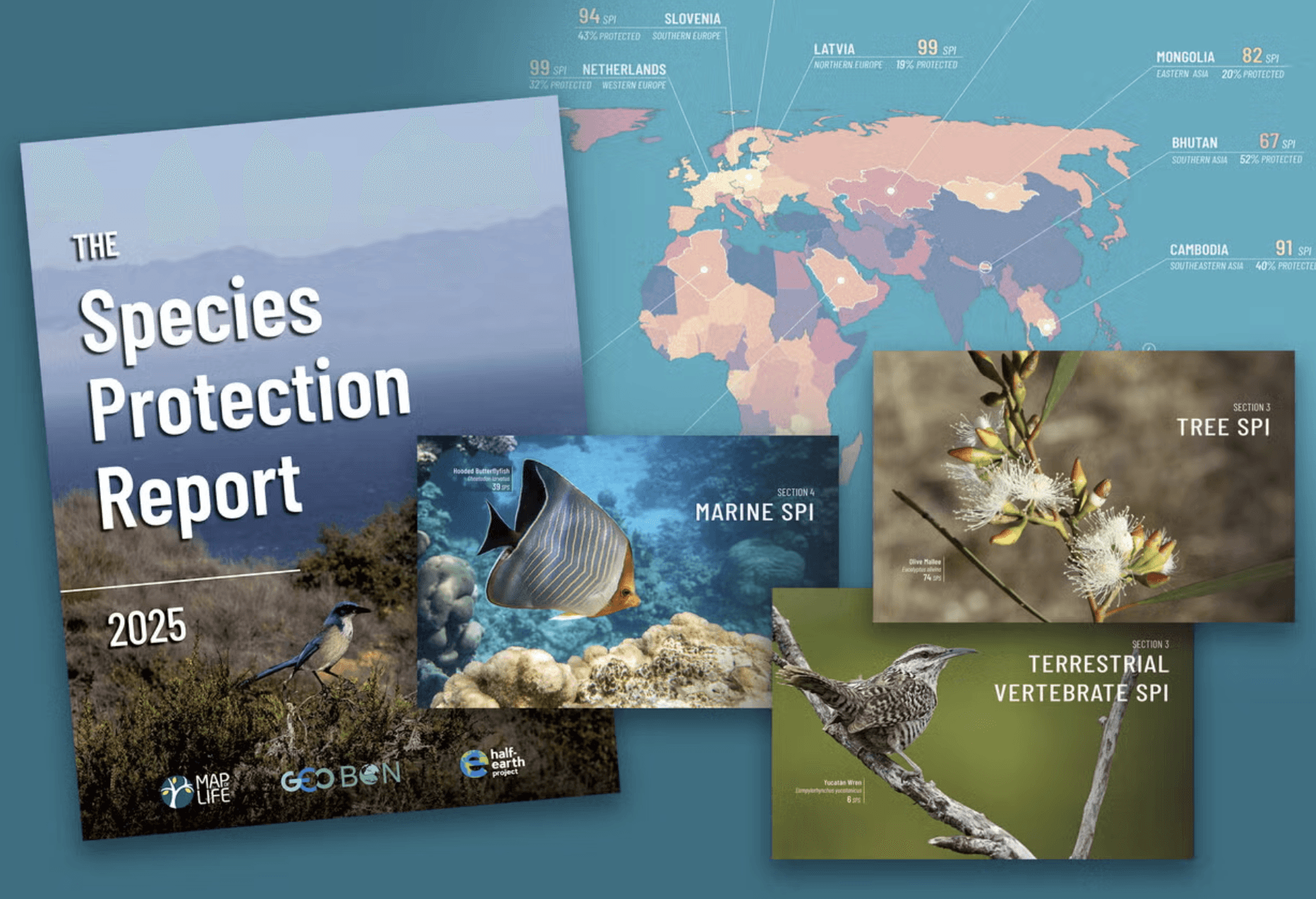
‘Map of Life’ report reveals strides in biodiversity conservation — but much work remains
Published: December 19, 2025
ARCGIS STORYMAP
The Species Protection Report: 2025
Published: October 29, 2025
ARCNEWS SCI CURRENTS

There’s Hope for Achieving New Biodiversity Targets
Published: December 19, 2025
ARCGIS STORYMAP
The Species Protection Index
Published: September 24, 2021
GOOGLE EARTH ENGINE
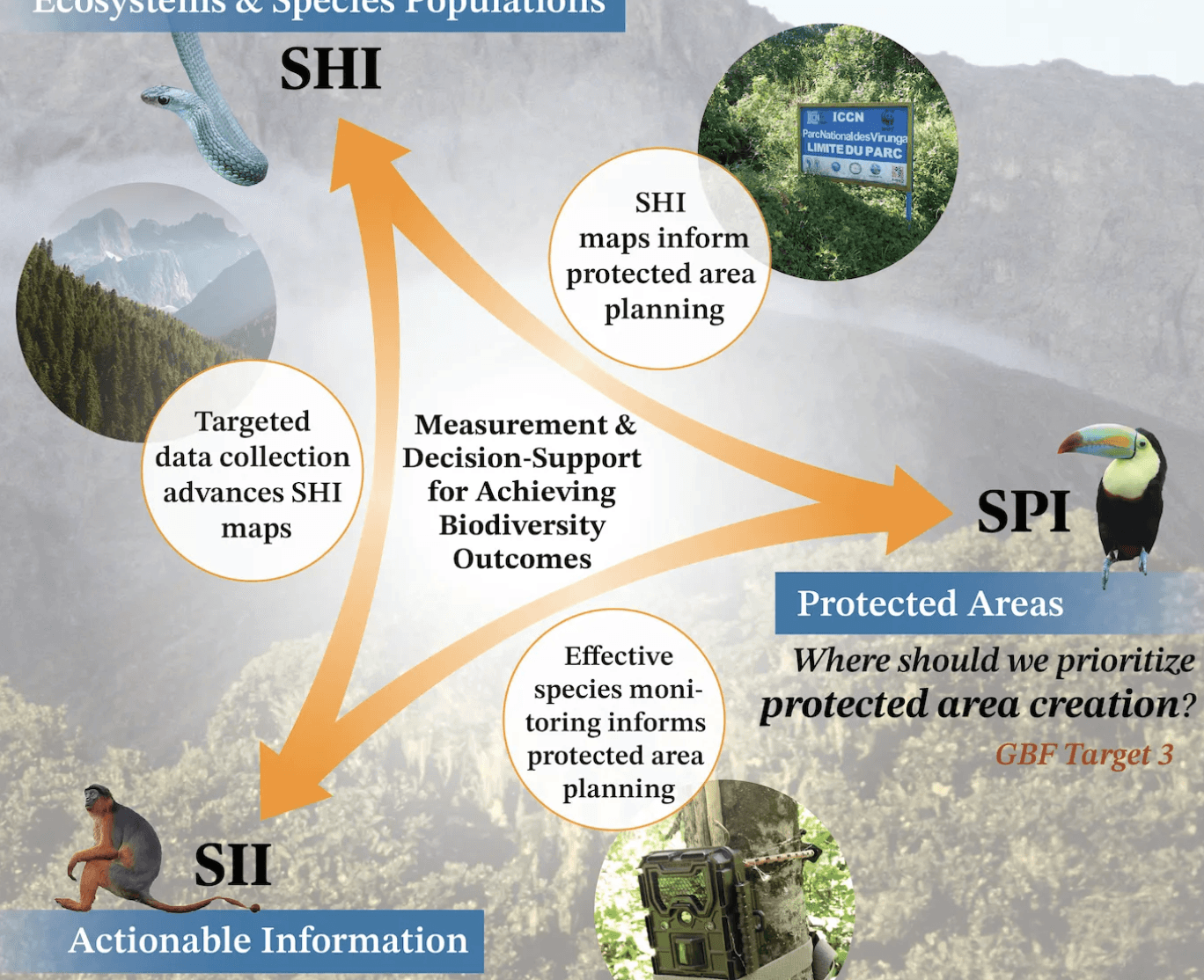
Map of Life Indicators adopted in UN Biodiversity Framework
Published: December 21, 2021
Methods
Protected areas
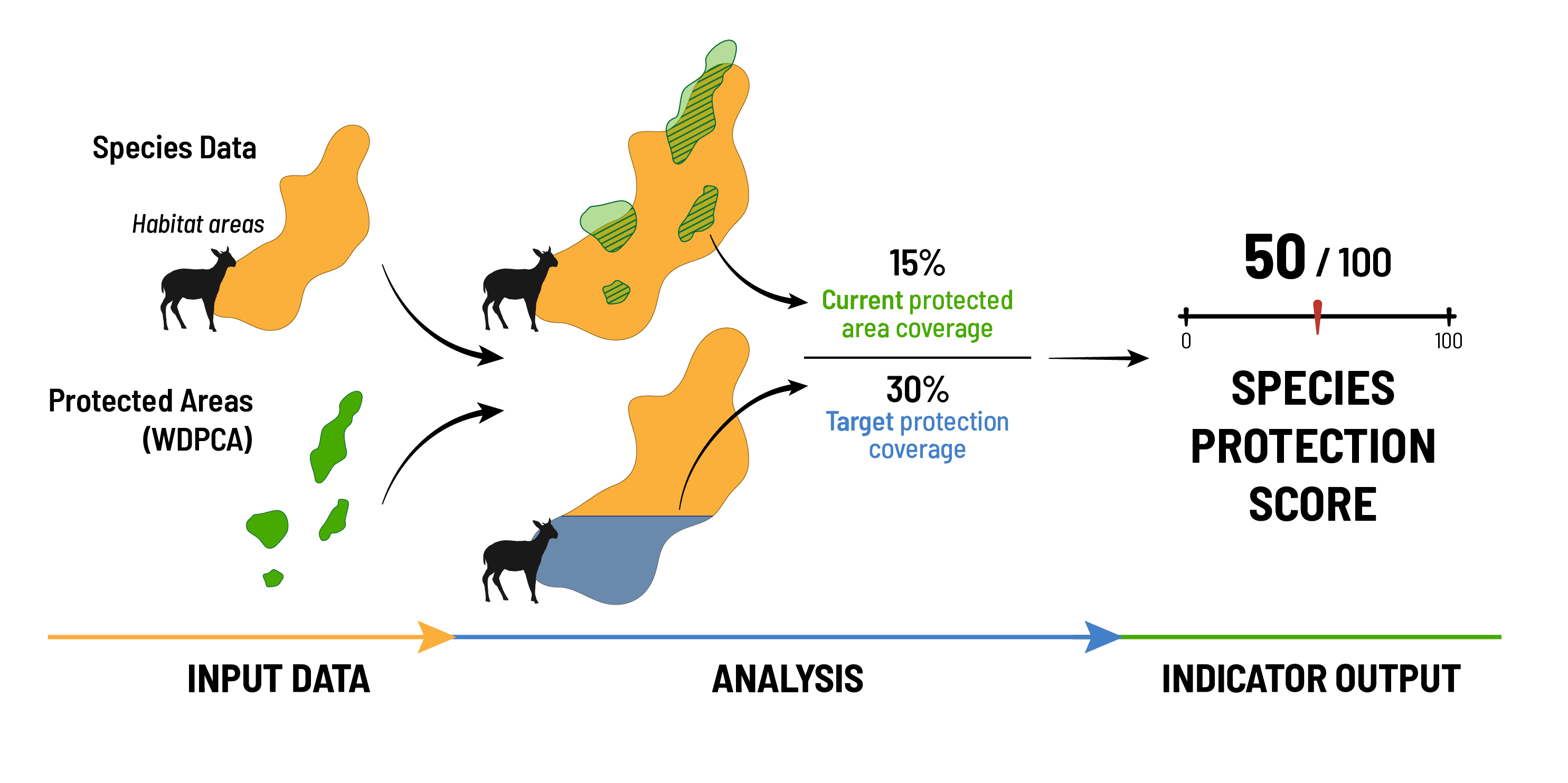
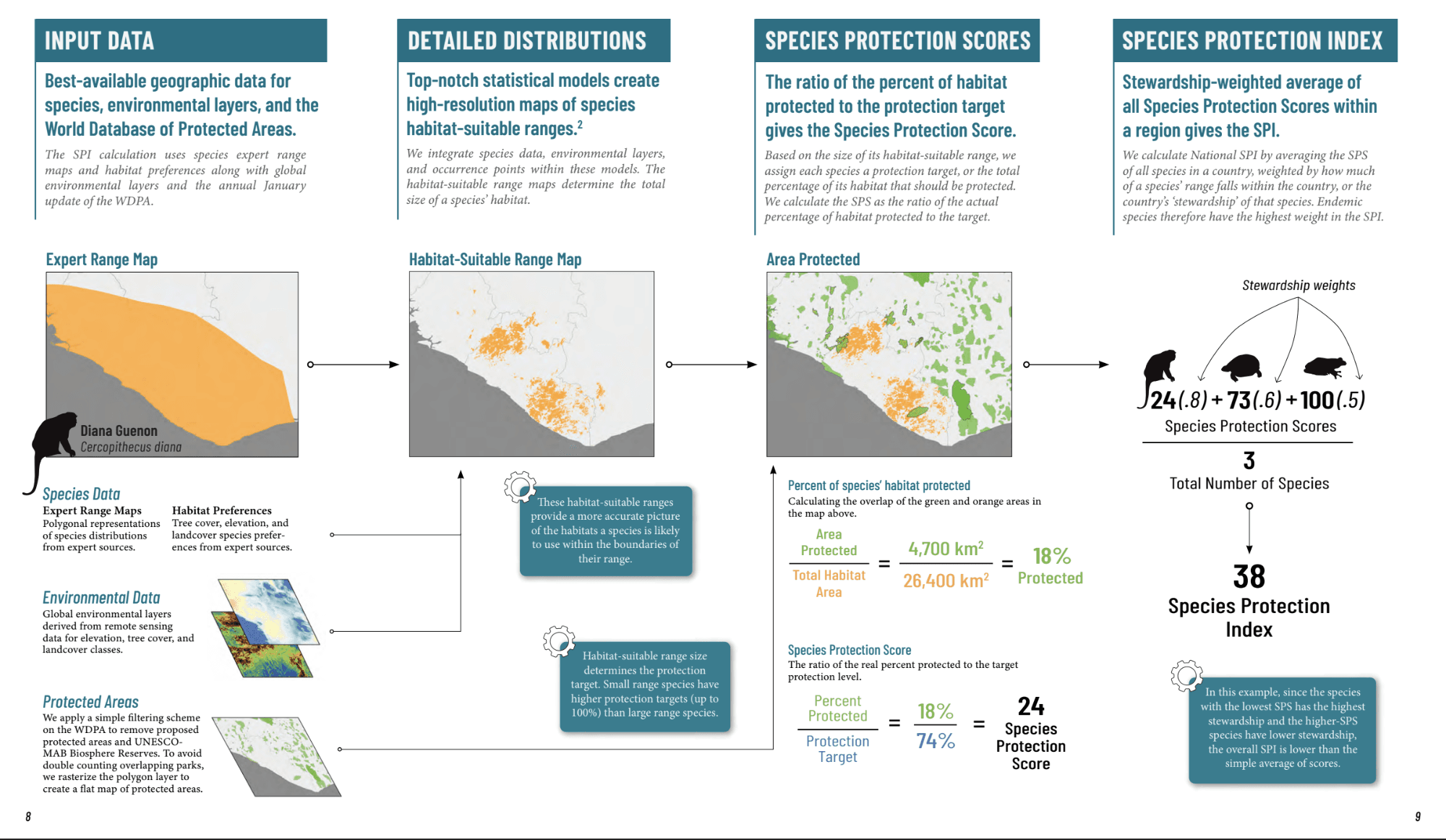
Protected area (PA) data are derived from the World Database on Protected and Conserved Areas (WDPCA). We note that for some countries, including China and India, this database only provides a portion of the actual reserve network. We followed the WDPCA's recommendations on cleaning data for calculations of global coverage and removed PAs without designated, inscribed, or established status, points without reported areas, and UNESCO-MAB Biosphere Reserves. For PAs lacking polygons and represented only as points, we created a buffer around data with the area of the buffer equal to the reported area of the PA. The PA polygons and buffered points were dissolved together, and intersected with a coastline from GADM 4.1. The results were then rasterized to a 1 km grid with values indicating percentage of PA cover in each grid cell, and then transformed to a Behrmann equal-area projection using bilinear interpolation.
Habitat-suitable range
We apply statistical models incorporating species expert ranges, habitat preferences, environmental layers, and species occurrence points to develop species habitat-suitable range maps. These maps represent the habitats within a species range boundaries where the species is most likely to inhabit and therefore provide a more accurate representation of the size and distribution of the species range.
Species-level scores
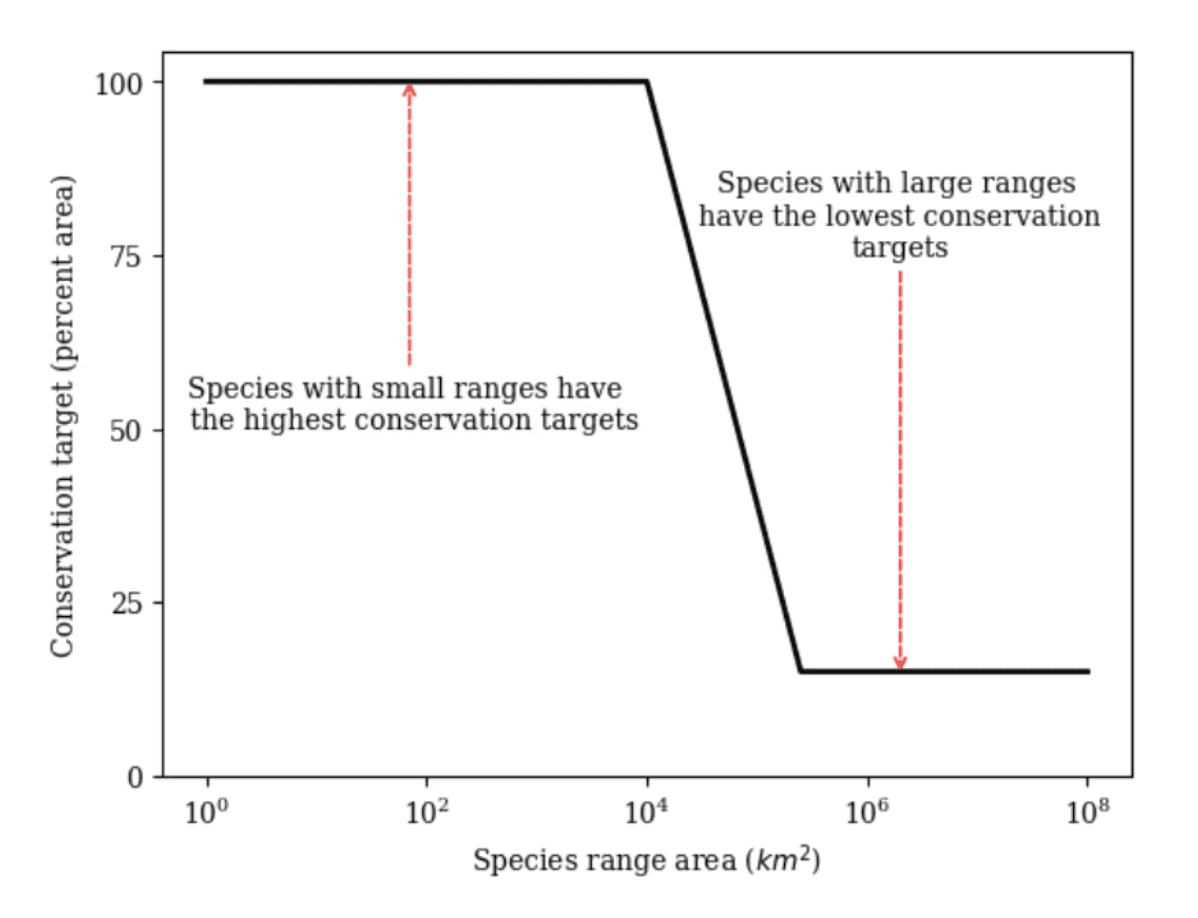
The SPI calculation is based on individual species protection scores (SPS). The SPS measures how much of a species' habitat-suitable range is currently under formal protection relative to how much conservation area we think is needed for its population to thrive.
National SPI
A country's national terrestrial SPI is the weighted average of all terrestrial vertebrate species in the country as defined by the borders in the GADM (see Sources). A country's national marine SPI is the weighted average of all marine fish and mammal species in the country's Exclusive Economic Zone (see Sources). Species scores are weighted by stewardship, or the percent of the species range within the country's borders. An endemic species (which has all of its range within one country) will therefore have the highest stewardship weight of 1.0, whereas a species with 10% of its range in a country will have a stewardship weight of 0.1. SPI values range from 0 and 100, where a value of 50 means that on average, species are half-way to sufficient representation in protected areas. Protected area additions that improve species representation will increase SPI values.
Sources
For the latest 2025 version of the SPI:
Species Range Maps
Species Group
Source
Amphibians
IUCN (2016). The IUCN Red List of Threatened Species. International Union for Conservation of Nature. Accessed on January 2017. Downloaded at www.iucnredlist.org
Birds
Jetz, W., et al. (2012). The global diversity of birds in space and time. Nature, (491);444-448. doi.org/10.1038/nature11631
Mammals
Mammal Diversity Database. (2020). Mammal Diversity Database (Version 1.2) [Data set]. Zenodo. doi.org/10.5281/zenodo.4139818. Map of Life. (2021). Mammal range maps harmonised to the Mammals Diversity Database [Data set]. Map of Life. doi.org/10.48600/MOL-48VZ-P413
Marine Fishes
Kaschner, K., et al. (2019). AquaMaps Native: Predicted range maps for aquatic species. Retrieved from https://www.aquamaps.org.
Marine Mammals
Kaschner, K., et al. (2019). AquaMaps Native: Predicted range maps for aquatic species. Retrieved from https://www.aquamaps.org.
Reptiles
Roll, U. and Meiri, S. (2022). GARD 1.7 - updated global distributions for all terrestrial reptiles [Dataset]. Dryad. doi.org/10.5061/dryad.9cnp5hqmb
Trees
Guo, WY., et al. (2023) Climate change and land use threaten global hotspots of phylogenetic endemism for trees. Nat Commun 14, 6950. doi.org/10.1038/s41467-023-42671-y
All groups
Misc. literature and expert sources
Species Habitat Preferences
Species Group
Source
Terrestrial vertebrates
IUCN Red List of Threatened Species. 2025. Version 2025-2. www.iucnredlist.org. Downloaded on 2025-04-22.
Terrestrial vertebrates
Misc. literature and expert sources
Environmental Layers
Dataset
Source
Elevation
Amatulli, G., et al. (2018) A suite of global, cross-scale topographic variables for environmental and biodiversity modeling. Scientific Data (5);180040. https://doi.org/10.1038/sdata.2018.40. Available at www.earthenv.org/topography.
Land cover
ESA. Land Cover CCI Product User Guide Version 2. Tech. Rep. (2017). Version 2022. Available at: maps.elie.ucl.ac.be/CCI/viewer/download/ESACCI-LC-Ph2-PUGv2_2.0.pdf
Tree cover
Hansen, M. C., et al. (2013) High-Resolution Global Maps of 21st-Century Forest Cover Change. Science 342 (15 November): 850-53. Version 2023. Data available online from: glad.earthengine.app/view/global-forest-change.
Region Layers
Dataset
Source
Country boundaries
Database of Global Administrative Boundaries (GADM) version 4.1. Available online at gadm.org/data.htm.
Exclusive Economic Zones
Flanders Marine Institute (2019). Maritime Boundaries Geodatabase, version 11. Available online at www.marineregions.org/. https://doi.org/10.14284/382
Protected areas
UNEP-WCMC and IUCN (2025), Protected Planet: The World Database on Protected Areas (WDPA) and World Database on Other Effective Area-based Conservation Measures (WD-OECM) [Online], January 2025, Cambridge, UK: UNEP-WCMC and IUCN. Available at: www.protectedplanet.net.
Citations & Acknowledgements
W. Jetz, M. A. McGeoch, R. Guralnick, S. Ferrier, J. Beck, M. J. Costello, M. Fernandez, G. N. Geller, P. Keil, C. Merow, C. Meyer, F. E. Muller-Karger, H. M. Pereira, E. C. Regan, D. S. Schmeller, E. Turak (2019). Essential biodiversity variables for mapping and monitoring species populations. Nature Ecology & Evolution. 3, 539-551. https://doi.org/10.1038/s41559-019-0826-1
W. Jetz, J. McGowan, D. S. Rinnan, H. P. Possingham, P. Visconti, B. O’Donnell, M. C. Londoño-Murcia (2021) Include biodiversity representation indicators in area-based conservation targets. Nature Ecology & Evolution. https://doi.org/10.1038/s41559-021-01620-y
Powers, R.P. & Jetz, W. (2019) Global habitat loss and extinction risk of terrestrial vertebrates under future land-use-change scenarios. Nature Climate Change, 9, 323-329. https://doi.org/10.1038/s41558-019-0406-z
D. S. Rinnan, Y. Sica, A. Ranipeta, J. Wilshire, W. Jetz (2021). Multi-scale planning helps resolve global conservation needs with regional priorities. bioRxiv 2020.02.05.936047. https://doi.org/10.1101/2020.02.05.936047
D. S. Rinnan, , G. Reygondeau, J. McGowan, V. Lam, R. Sumaila, A. Ranipeta, K. Kaschner, C. Garilao, W. L. Cheung, W. Jetz (2021). Targeted, collaborative biodiversity conservation in the global ocean can benefit fisheries economies. bioRxiv 2021.04.23.441004. https://doi.org/10.1101/2021.04.23.441004
IPBES (2019) Global assessment report on biodiversity and ecosystem services of the Intergovernmental Science-Policy Platform on Biodiversity and Ecosystem Service. In: eds. E.S. Brondizio, J. Settele, S. Díaz and H.T. Ngo), p. 1148. IPBES Secretariat, Bonn, Germany.
Environmental Performance. "Environmental performance index." Yale University and Columbia University: New Haven, CT, USA (2018).
CBD Secretariat (2021). CBD/WG2020/3/INF/6. 24 August 2021, Montreal. https://www.cbd.int/doc/c/2397/5133/3ce87fa6c735a7bf1cafb905/wg2020-03-inf-06-en.pdf