

Species Information Index
Overview
A METRIC OF
SPECIES MONITORING

COMPONENT INDCATOR OF
TARGET 21
TAXONOMIC COVERAGE
TERRESTRIAL:




Media & Presentations
Methods
All data and scripts to support Oliver et al. 2021 can be found in the following GitHub repository: https://github.com/MapofLife/biodiversity-data-gaps
Taxonomic harmonization
To prevent missing or double-counting species due to synonymy, all scientific names in GBIF and range map datasets are harmonized under common taxon concepts. For this purpose, we carefully developed synonym lists to match species names in GBIF-mediated data to names used for the expert information. For each major species group, we selected a well-curated taxonomic database as our ‘master taxonomy’, that defines accepted species delimitations. To each accepted species name, we linked additional scientific names that are fully or partly included in the respective taxon concept, including synonyms, subspecies, and typographical variants and spelling mistakes. To be able to interpret all scientific names in range map and GBIF datasets, we integrated our master taxonomies with various additional sources of scientific names. Any remaining non-matching names were matched using approximate string matching and afterwards individually validated.
Scientific name resolution
The SII considers species native ranges only. To validate records geographically, we excluded any records that fell outside of the respective species’ known extents of native occurrence (as inferred from gridded range maps). A major problem with records in aggregative databases is that the originally intended taxon concepts behind ambiguous scientific names (such as many pro parte synonyms) are typically unknown. However, these can often be inferred indirectly from records’ geographical locations. Here, we do so by inferring taxonomic identities of ambiguously named records through spatial overlays with the range maps of all accepted species to which these names could potentially refer. In cases where ambiguously named records overlap with ranges of more than one ‘candidate’ accepted species, we assume that these names reflect the taxon concepts in our master taxonomy. If ambiguities still persist, we assume that all records of a given ambiguous name in a given grid cell refer to only one of the candidate accepted species, hence our completeness index may be slightly conservative in these cases.
Species-level scores
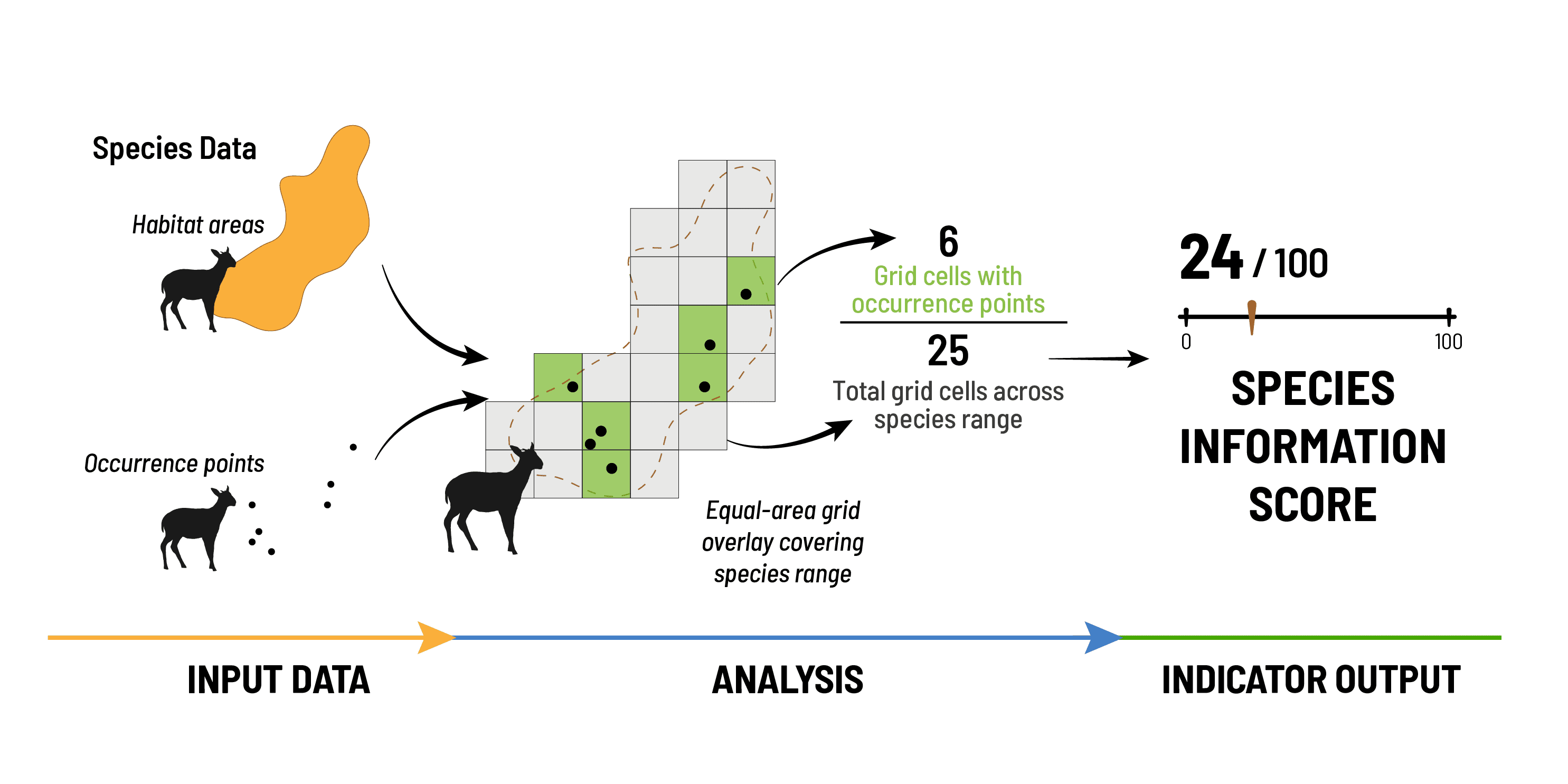
The SII calculation is based on individual species information scores (SIS). The SII measures how well the existing data covers a species’ expected range. A global equal area grid (ca. 110-km resolution) is overlaid on the species expert range to give the gridded expected range, then the SIS is simply calculated as the proportion of total grid cells that contain a documented occurrence point in a given year. This calculation can be performed across the species entire global range or across just the portion of range within a given country.
For example, a species whose range covers ten grid cells will have an SIS of 50 if exactly five of those cells contain at least one occurrence point.
National SII
A country’s national SII is calculated as the simple average of the within-country SIS values across all species. The national SII can also be computed as a weighted mean where each species is weighted by stewardship, or the percent of its range that is within the country. The SII therefore measures how well, on average, species occurrence data cover the expected ranges of species within a country across a given year from 0 to 100. A large number of occurrence records will not necessarily lead to a high SII if those records poorly represent biodiversity, for example, if the data is repeatedly coming from just a small portion of species or locations. The SII may fluctuate significantly between years.
Sources
For the latest 2024 version of the SII:
Species Range Maps
Species Group
Source
Amphibians
IUCN (2016). The IUCN Red List of Threatened Species. International Union for Conservation of Nature. Accessed on January 2017. Downloaded at www.iucnredlist.org
Birds
Jetz, W., et al. (2012). The global diversity of birds in space and time. Nature, (491);444-448. doi.org/10.1038/nature11631
Mammals
Mammal Diversity Database. (2020). Mammal Diversity Database (Version 1.2) [Data set]. Zenodo. doi.org/10.5281/zenodo.4139818. Map of Life. (2021). Mammal range maps harmonised to the Mammals Diversity Database [Data set]. Map of Life. doi.org/10.48600/MOL-48VZ-P413
Reptiles
Roll, U. and Meiri, S. (2022). GARD 1.7 - updated global distributions for all terrestrial reptiles [Dataset]. Dryad. doi.org/10.5061/dryad.9cnp5hqmb
Terrestrial vertebrates
Misc. literature and expert sources
Species Occurrence Points
Species Group
Source
Terrestrial vertebrates
GBIF.org (1 September 2024) GBIF Occurrence Download.
Taxonomic Data
Species Group
Master Taxonomy
Other Sources of Names
Amphibians
AmphibiaWeb 2019
ITIS, IUCN, Wikipedia, Frost
Birds
Clements et al. 2019
ITIS, IUCN, AViBase
Mammals
Upham et al. 2019
Wilson and Reeder 2005, Mammal Diversity Database V2, IUCN, Wikipedia
Reptiles
Uetz et al. 2019
ITIS, IUCN, Wikipedia
Region Layers
Dataset
Source
Country boundaries
Database of Global Administrative Boundaries (GADM) version 4.1. Available online at gadm.org/data.htm.
Citations & Acknowledgements
Hurlbert, A. H., and W. Jetz. (2007). Species richness, hotspots, and the scale dependence of range maps in ecology and conservation. PNAS 104 (33) 13384-13389. https://doi.org/10.1073/pnas.0704469104
Meyer, C., H. Kreft, R. Guralnick, and W. Jetz. (2015). Global priorities for an effective information basis of biodiversity distributions. Nature Communications 6: 8221. https://doi.org/10.1038/ncomms9221
Oliver, R. Y., Meyer, C., Ranipeta, A., Winner, K., & Jetz, W. (2021). Global and national trends, gaps, and opportunities in documenting and monitoring species distributions [Data set]. PLOS Biology 19 (8): e3001336. https://doi.org/10.1371/journal.pbio.3001336